
These short pieces were originally written for my nature newsletter, What are you looking at? (AKA: WAYLA?) They are from issue 51 which I sent out just before the Autumn Equinox of 2021. I’m reposting them here as they originally went only to my subscribers. I’ve recently relaunched this newsletter on Substack. Please click here to subscribe!
Ivy bees
The story starts on the allotment. Not on my plot but on one of my husband’s neighbour’s plots. Her strawberry patch was covered in bees, dozens and dozens of them. Strawberry season is well past so they weren’t after flowers, but they were busily buzzing, crawling and flying all over the patch, even on the bare soil between the plants. Their motion was so constant I could barely get a proper look at an individual bee. I resorted to binoculars and saw small bees, with apparently hairless bodies that rather resembled black and amber beads. On the thorax a small tuft of gingery hair. They also seemed to have quite big eyes and short antennae. We imagined them to be some type of solitary mining or mason bee, but on looking through the field guide they really didn’t look much like any of them.
Then it dawned on me, that there is a species of bee which comes into its own at this time of year. Late summer and autumn is the season of the ivy bee – so-called because it feeds on the flowers of ivy. The field guide confirmed this and described males emerging first, followed by females a week or so later. Although they like to hang out together and seem to form colonies, the ‘solitary’ description is because they nest in single cells, laying eggs which presumably stay underground throughout winter and spring until the new bees emerge the following summer/autumn – just as the ones I was looking at must have done.
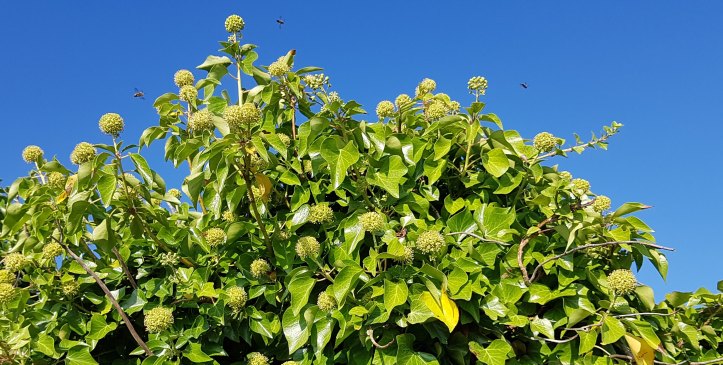
Later in the week I decided to check out the local ivy bushes to see if it really is ivy bee season – and it seems that it is. Ivy bushes are abundant on the cliff tops near where I live and on the fences fringing the golf course. The sunniest of these were, quite literally, abuzz with ivy bees (along with hoverflies and the odd wasp). Each clump of ivy I checked had some buzzing round it and although they must land to feed, it seemed as though they were hardly ever still. I managed a photo of one, but it wasn’t really ready for its close up.
So if you see a mass of bees around some ivy in the coming weeks, now you know what’s going on (and that ivy is really a very useful plant and not the tree-strangling nasty it’s made out to be!).
The summons, or, what a difference a hedge makes
I was summoned into the front garden by my husband this week and told that I’d want to bring my camera. “Do I need to run?” I asked. “No, it’ll still be there,” he replied, enigmatically.
Unless he’d pointed it out I’m not sure how long it would have taken me to spot it. It was a huge, green caterpillar, bigger than my index finger and it appeared to be crawling up one of the branches of the hedgerow. An allotment neighbour had showed us a photo of a similar beast recently, but this one had different markings.
As my husband had pointed it out, the caterpillar seemed wary and began to take some sort of evasive action. That makes it sound like it started to crawl away at speed. It didn’t. It simply curled backwards a little bit, which had the effect of making it look very much like a leaf.
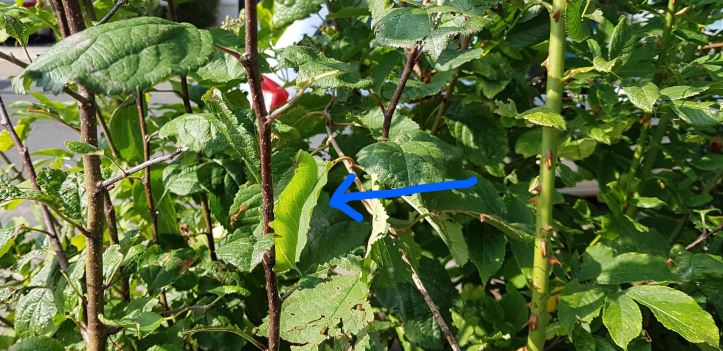
We decided to leave it in peace (sorry, ‘leaf’ it in peace) and go inside to look up what sort of caterpillar it might be. After comparing a few of similar appearance, it seemed ours was the caterpillar of a poplar hawk-moth, which I hope will inspire me to actually set up my moth monitoring trap next year instead of just thinking about it. Not least because poplar hawk-moths are pretty huge and magnificent and I’ve never seen one.
The moth that laid the egg which became this caterpillar was likely attracted to our rather wild garden. Specifically it must have been attracted to the native hedgerow my husband planted as a replacement for some crappy ornamental shrubs that were there when we moved in. These might as well have been made of plastic for all the wildlife they supported – or rather didn’t support. Now we have a mixture of wild cherry (one of the poplar hawk- moth caterpillar’s preferred food plants) dog rose, elderberry, willow, blackthorn and beech and huge visiting caterpillars! What a difference a native hedgerow makes. I wonder what we’ll find in it next?
If you enjoyed reading this please consider subscribing to my What are you looking at? newsletter on Substack. Subscriptions are currently free…
 Sophie Atherton