These short pieces were originally published in issue 87 of my WAYLA? (What are you looking at?) nature-writing newsletter around May Day of 2023. It was only sent to subscribers at the time, so I’m now re-posting it here.
Eiders
In winter, and even in the cold start to this spring, who wouldn’t have rather been snuggled in an eiderdown than out for a damp chilly walk? Remember the eiderdown? Perhaps it’s a thing of the past now that we have duvets. Then again I often see people walking around in coats that resemble sleeping bags, so perhaps they are the new eiderdowns?
Perhaps eiderdowns belong in the past, given what I presume they are made of. The downy feathers of an eider duck. Have you ever seen an eider duck? I doubt you’ve spotted one on your local pond, for these are sea-going fowl which rarely venture into fresh water. If you’re as lucky as I’ve been perhaps you’ve spotted them along the coast a few times, or even nesting (when they apparently make use of their own down to line said nests!) up north near brackish water.
The male of the species, for the sexes are obviously different, is white and black. His most striking feature to my eyes is that he appears to be wearing a black cap with a pointed peak. Sometimes bird books declare a bird ‘unmistakeable’ and I wonder who the author thinks it is unmistakeable to. Then there are eiders, or at least the males.
Far out to sea, on a dull spring day, I was watching a gull through my bins. It was flying above the waves and repeatedly dropping an item onto the surface of the water, as if trying to break open the shell of a mussel as the local crows do on the shore. Of course the water wasn’t playing ball and all that happened was another gull took an interest and stole the mystery booty. Had I not been looking at this drama, I would not have spotted the eiders.
I recognised them immediately, the stark contrast between the black crown and the creamy white body standing out despite the dull light. They were like a beacon to me. Two shiny males in the company of a less flashy female friend. One by one they disappeared under the waves in search of lunch. One by one they reappeared, their meals secured. While on the shore my connection with the rest of nature was refreshed.
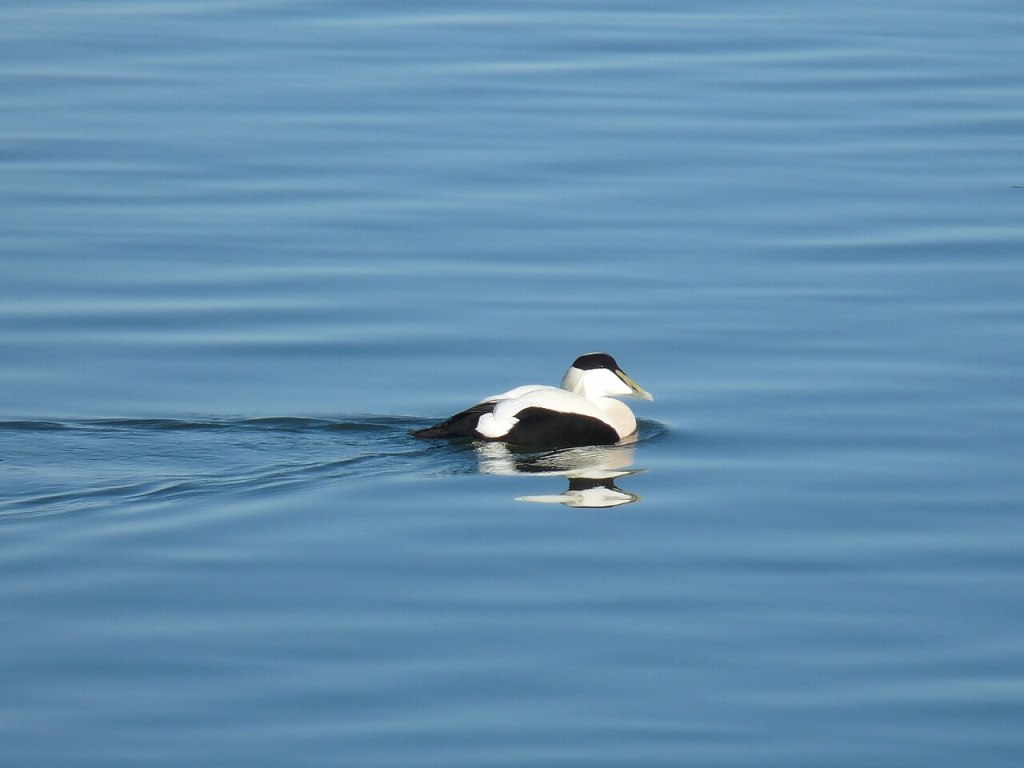
Left: a male eider duck (pic by nottsexminer licensed under CC BY-SA 2.0)
Woody v the magpie
Spring is upon us. No doubt now. Flowers are blooming, bees are buzzing and the birds are singing. My favourite blackbird song once again floats through the neighbourhood and I’ve seen my first swallows. The early mornings are light and the daylight lasts long enough to take an evening stroll.
A season of colour, of life and of fighting! I’m not a full on pacifist, but I’m not keen on fighting and loathe sports like boxing. You’d go to prison if you did it outside a pub on a Saturday night, yet put it in a special ring and add the possibility of massive profits, and knocking seven shades out of someone becomes ok?! But I digress. There is a form of scrapping that amuses me and it is when wood pigeons fight. It’s partly the ‘See you, Jimmy!’ aspect – lacking actual arms, it’s mostly headbutting interspersed with shoving and flapping. For some reason, maybe that it never gets truly horrible, I feel compelled to watch and will even call my husband to join me. “Pigeon fight! Quick or you’ll miss it!”
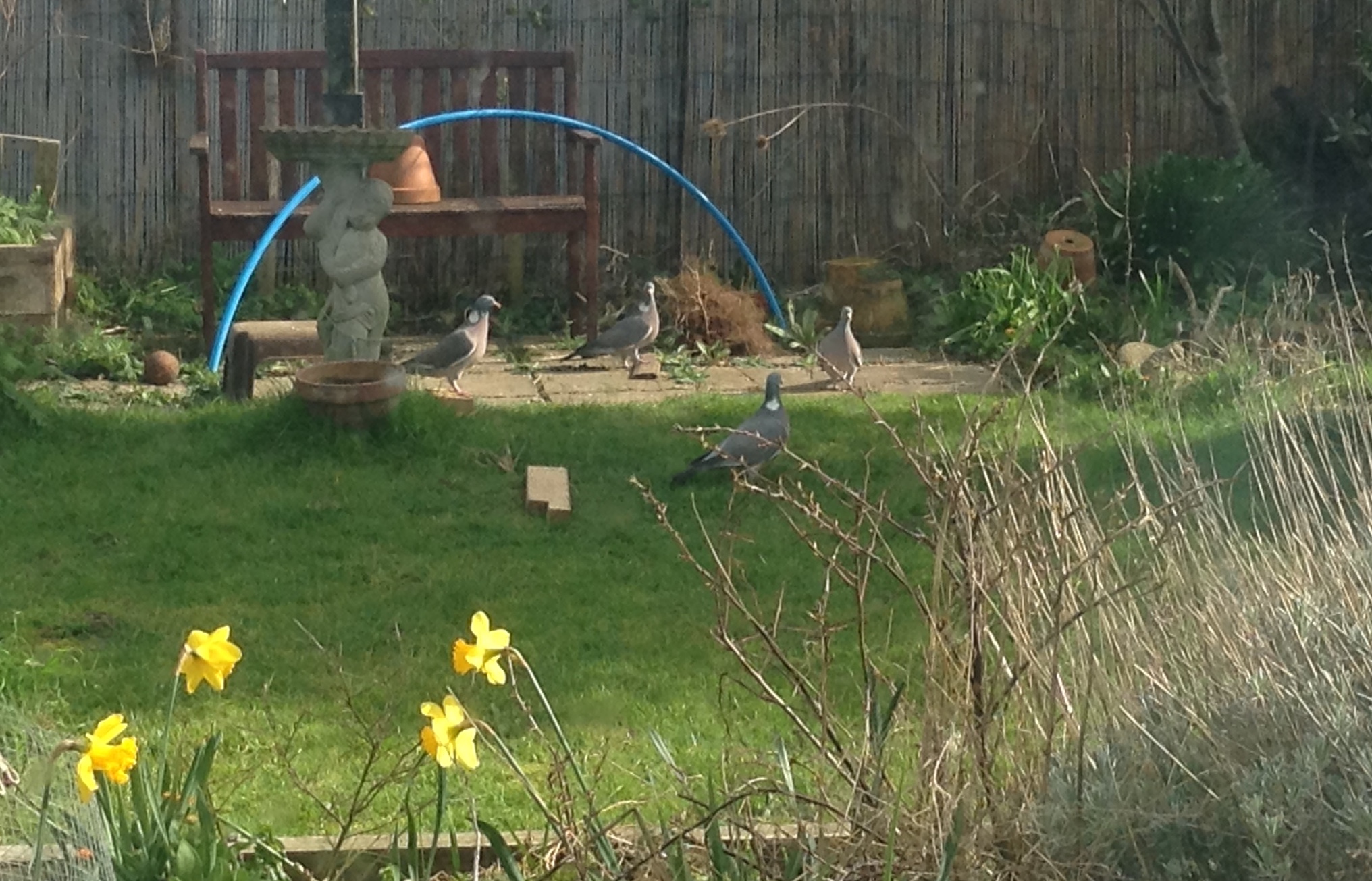
This week though, Woody decided to fight someone other than another pigeon. Maybe fight is the wrong word. It was more like standing up to a bully. There was none of the slapstick headbutting and pushing, just a pigeon determined to get some breakfast. He (or she, but perhaps the males are more likely those who scrap over territory?) raised his wings and tried to be a giant pigeon looming over the smaller black and white pied bird, who merely weaved round, grabbed some suet and flew off. It then returned for more and Woody raised his wings again. He looked majestic and powerful. He’d not let this magpie take all the food! The magpie grabbed more and flew off before returning a third time and greeting Woody’s stance with a double-footed kick to the pigeon’s breast, knocking him out of the ring. I mean, off the top of the compost box where the food was.
I saw the blow, but missed the knock out. Woody was not quite out for the count though. He withdrew to the nearby patio where I swear I heard him cooing, “But I coulda had class. I coulda been a contender.”
Look out for moths (for angle shades)
I’m not sure anyone enjoys weeding, although there is a sort of rhythmic, repetitive quality to it that makes it quite relaxing but at the same time absorbing enough to take your mind off things. The trouble I have with it, beyond the twinges, aches and pains it sometimes causes, is the guilt at pulling up perfectly good plants that could feed some other creature, especially if the creature in question is a bee I’m depriving of a flower. I console myself that I have permission to allow my own food plants to take precedence and that growing my own food, not far from where I live, means less pressure on the environment.
Sometimes when weeding I also disturb creatures, especially ants who have no idea about ‘location, location, location’, but also soil dwelling grubs and such which sometimes then become food, usually for a robin who has been watching in the hope edible critters will be exposed by the human activity.
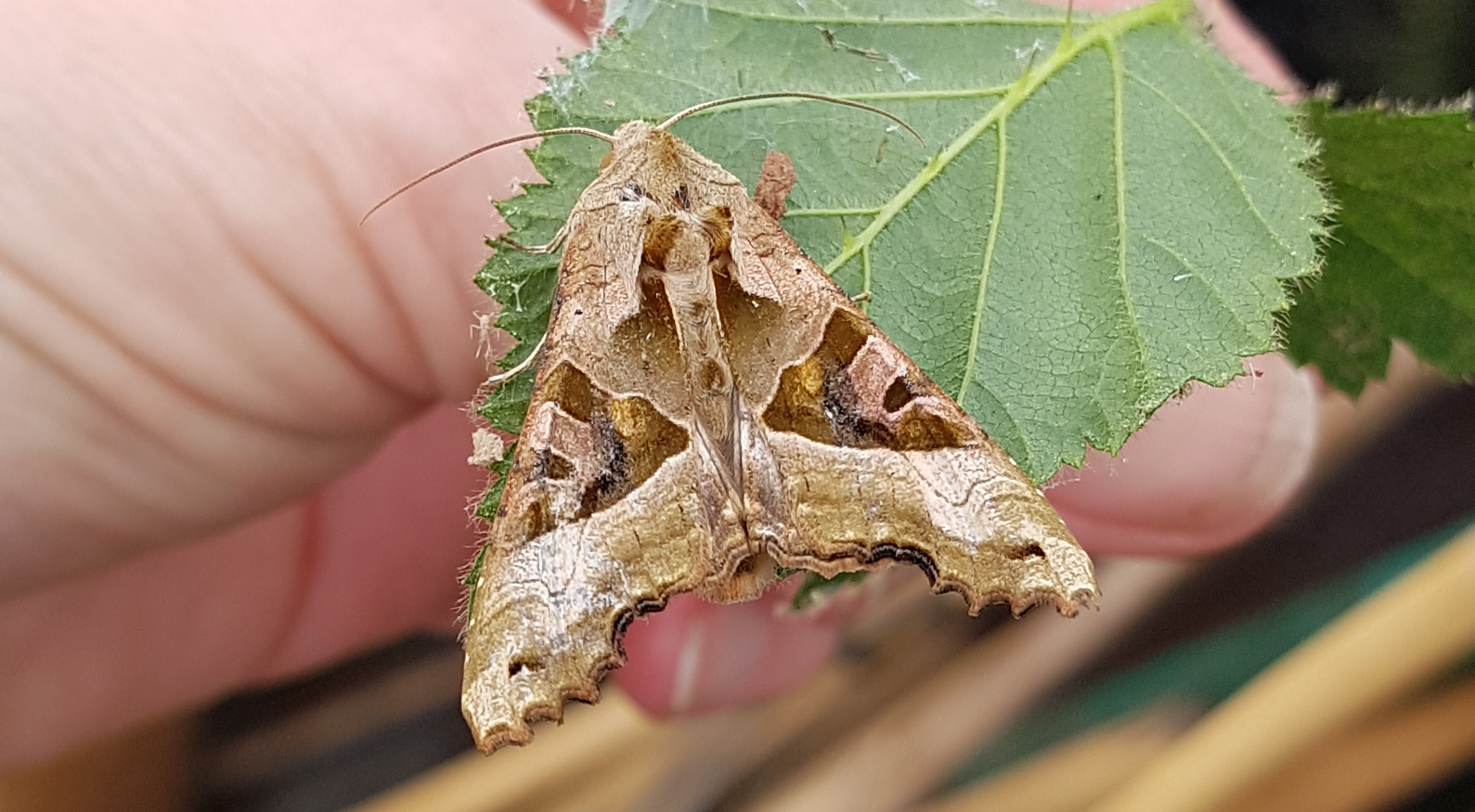
In my polytunnel recently though, as I challenged small brambles and cleared weeds in preparation for this year’s tomato crop, I nearly squashed a moth. It wasn’t actually during the weed pulling itself but as I went to gather up a pile of baby brambles I’d tugged out. As I grabbed them I saw movement and realised a moth was trying to take refuge in the leaves. Despite my thick bramble-protection gloves, I managed to pick up the leaf it was on and carry it to the safety of a makeshift moth shelter – in the shape of a grubby plastic bottle I’d previously been using as a tomato waterer.
Before I tucked it away though, I photographed it for you (see below). This moth species is apparently common but I’ve only seen it a few times. It is named angle shades for the gorgeous shape of its wings – by which you can recognise it should you come across one.